
Description
Mualliflar:
Soatov N.M. – Iqtisod fanlari doktori, professor,
O`zbekistonda xizmat ko`rsatgan fan arbobi;
Nabiev X.G‟. – Iqtisod fanlari doktori, professor,
O`zbekistonda xizmat ko`rsatgan ta‘lim xodimi;
Nabiev D.X. – Iqtisod fanlari doktori, professor;
Tillaxo`jayeva G.N. – Katta o`qituvchi.
Taqrizchilar:
iqtisod fanlari doktori,
O`zbekistonda xizmat ko`rsatgan fan arbobi,
professor Abdullayev Yo.
TDIU ―Statistika‖ kafedrasi mudiri
AYUBJONOV A.X.
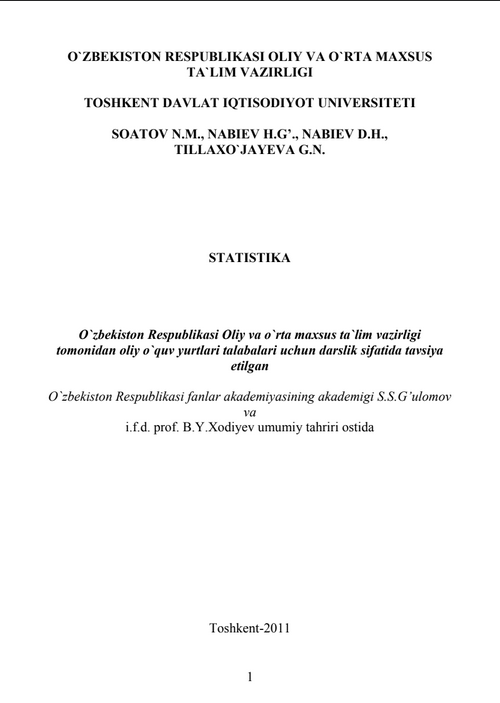
O`zbekiston Respublikasi Fanlar Akademiyasining akademiki S.S.G`ulomov va
i.f.d. prof. B.Y.Xodiyev umumiy tahriri ostida
Annotatsiya
O‘bekistonda bozor iqtisodiyoti rivojlanayotgan sharoitida, mutaxassislar tayyorlash sifatini tubdan yaxshilash hozirgi zamon dolzarb
masalasi bo‘lib, u barcha fanlar bo‘yicha mazmunli darsliklar yaratishni taqozo qiladi.
Ushbu darslikda statistika yagona fan sifatida qaralib, 2 qismga ajratilgan:
I qism. Statistika nazariyasi
II qism. Iqtisodiy statistika
I qismda statistika predmeti va metodi, statistik kuzatish uslubiyati, statistik ko‘rsatkichlar, axborotlarni jadval va grafiklar yordamida taqdim
etish usullari, ma‘lumotlarni tasniflash va guruhlash, taqsimot qatorlari, o‘rtacha miqdorlar va variatsiya ko‘rsatkichlari, tanlama kuzatish,
korrelyatsion va regression tahlil, dinamika qatorlari, iqtisodiy indekslar kabi mavzular batafsil bayon etilgan.
II qismda milliy hisoblar tizimi – iqtisodiy statistikaning uslubiy negizi sifatida qaralgan va barcha masalalar shu asosda yoritilgan. Aholi,
mehnat bozori va milliy boylik statistikasiga butun iqtisodiy faoliyatning muhim omillari sifatida qaralgan. Makroiqtisodiy faoliyat natijasi sifatida
yalpi ichki mahsulot statistikasi o‘rganilgan.
Tashqi iqtisodiy faoliyat va moliya-kredit tizimi statistikasiga alohida e‘tibor berilgan. Aholi turmush darajasi, jamiyat miqyosida yaratilgan
daromad hajmiga bog‘liq bo‘lib, darslik aholining daromadlari va harajatlari balansi asosida uning turmush darajasi ko‘rsatkichlari chuqur tahlil
etilgan.
Darslik barcha iqtisodiy oliy o‘quv yurtlari va fakultetlari talabalari va magistrlari uchun mo‘ljallangan. Undan amaliyotda faoliyat olib
boruvchilar ham foydalanishlari mumkin.
Аннотация
В условиях развития рыночных отношений в Узбекистане, повышение качества подготавливаемых специалистов является
требованием времени, а это в свою очередь обусловливает подготовку содержательных учебников.
В данном учебнике статистика рассмотрена как единая дисциплина и состоит из двух частей:
I – часть. Теория статистики.
II – часть. Экономическая статистика.
В первой части подробно изложены следующие вопросы: предмет и метод статистики, методы статистического наблюдения,
статистические показатели, представление информации в таблицах и графиках, сводка и группировка данных, ряды распределения,
средние величины и показатели вариации, выборочное наблюдение, корреляционный и регрессионный анализ, ряды динамики и
экономические индексы.
Во второй части – система национальных счетов рассмотрена как методическая основа экономической статистики и все вопросы
освящены на этой основе.
Статистика населения, рынка труда и национального богатства рассмотрены как основные факторы экономической деятельности.
Валовой внутренний продукт отражает результат макроэкономической деятельности всей страны.
Особое внимание уделено статистике внешне экономической деятельности и финансово-кредитной системы. Жизненный уровень
населения зависит от массы дохода созданного обществом за определенный период и в учебнике показатели уровня жизни народа
рассмотрены и анализированы на основе баланса доходов и расходов населения.
Учебник предназначен для студентов и магистров всех экономических вузов и факультетов. Им могут пользоваться и практические
работники статистических органов.
Annotation
On condition of development of market relations in Uzbekistan, rising the quality of training specialists are required in our time, and this in
its turn depends on preparation for rich in content literatures.
In this literature the statistics is considered as one discipline and consists of two parts:
I – part. Theory of statistics.
II – part. Economic statistics.
In the first part the following questions are set in detail: subject and method of statistics, methods of statistical observation, statistical indices,
presented information in tables and schedules, report and grouping facts, distribution, middle quantity and indices of variation, selective observation,
correlation and regressive analyses, dynamics and economic indices.
In the second part – the system of national accounts is considered as methodical basis of economic statistics and all questions are consecrated
on this basis.
Statistics of population, labor market and national wealth are considered as basic factors of economic activity. Gross national product reflects
the result of macroeconomic activities of all countries.
Special attitude is given to statistics of foreign economic activities and financial-credit systems. Living level of people depends on mass
income created by society for definite period and in the literature indices of the living level of people are considered and analyzed on the bases of
balance of income and expenses of population.
Literature is intended for the students and holders of master‘s degree of all economic institutions and faculties. It can be used by practical
workers of statistical agencies.


Reviews
There are no reviews yet.